
Cooling Tower Condensate Recycling for Industrial Facilities
Cooling tower condensate recycling captures water produced by air handling units (AHUs), fan coil units and other cooling coils. The recovered water is collected, treated and monitored for reuse as cooling tower make-up water.
In Singapore’s humid climate, large air-conditioning systems can generate a dependable condensate stream whenever cooling demand and outdoor humidity are high.
Instead of sending this clean, low-mineral water to the drain, a properly engineered recovery system can reduce freshwater or NEWater demand, lower discharge volume and strengthen a facility’s water-resilience programme.
World Technologies provides end-to-end delivery—from water auditing, flow measurement and feasibility studies through process design, equipment supply, installation, commissioning, performance verification and operational support.
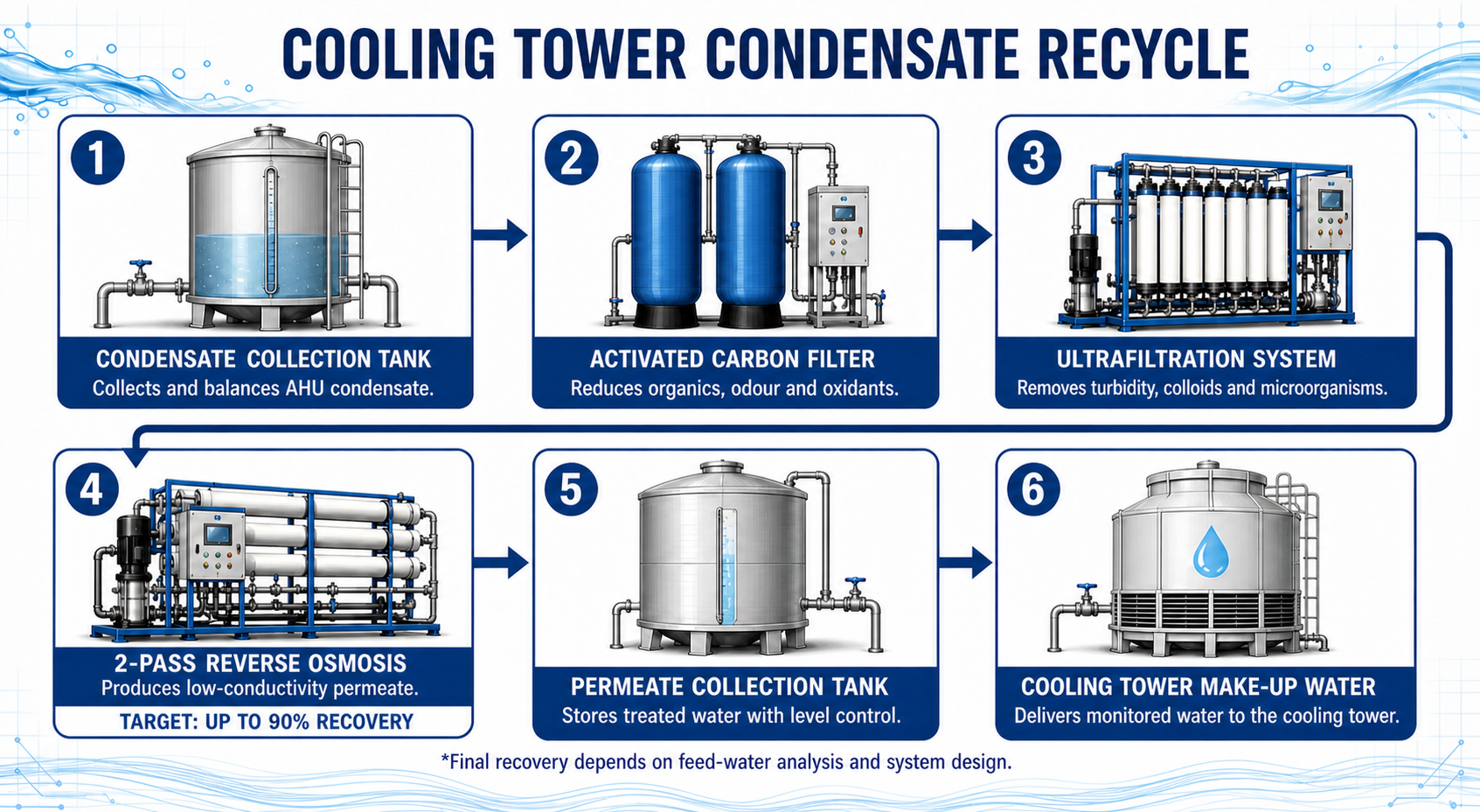
Updated treatment workflow: Condensate Collection Tank → Activated Carbon Filter → Ultrafiltration System → Two-Pass Reverse Osmosis System with a target of up to 90% overall recovery → Permeate Collection Tank → controlled delivery as cooling tower make-up water.
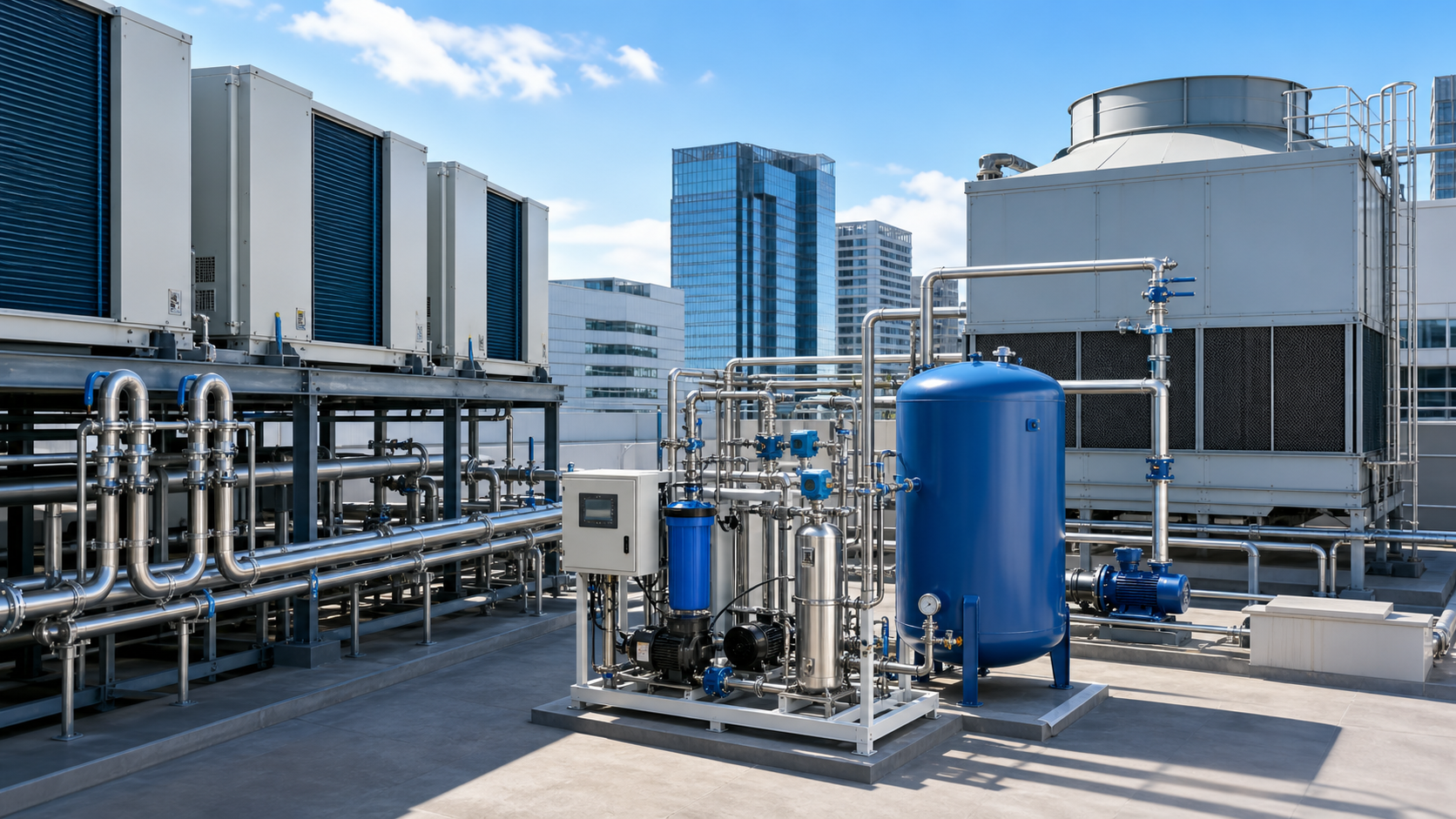
What Is Cooling Tower Condensate Recycling?
Warm, humid air releases moisture when it passes across a cold cooling coil inside an AHU. The moisture collects in a drain pan as air-conditioning condensate. This water normally has low total dissolved solids because it originates from water vapour rather than a mineral-bearing supply.
Low mineral content can make AHU condensate an attractive alternative source of cooling tower make-up water. It may dilute minerals entering the cooling-water circuit and, depending on the complete water chemistry, can support higher cycles of concentration. However, condensate is not automatically ready for every application. Dust, microbial growth, corrosion products, cleaning chemicals or metals picked up from coils and drainage systems must be evaluated and controlled.
A professional design therefore treats condensate recycling as an engineered non-potable reuse system. For this solution, World Technologies uses activated carbon, ultrafiltration and two-pass reverse osmosis to provide a controlled permeate quality before storage and delivery to the cooling tower.
How the Condensate Treatment and Recovery Process Works
Key Design and Water-Quality Considerations
| Design parameter | Why it matters | World Technologies approach |
|---|---|---|
| Condensate quantity and variability | Production changes with humidity, cooling load, outside-air quantity and operating hours. | Drain survey, temporary flow logging and hourly or seasonal water-balance modelling. |
| Activated carbon loading | Organic compounds and oxidants can shorten membrane life or affect treated-water quality. | Laboratory analysis, carbon selection, contact-time design and monitored replacement planning. |
| UF feed and filtrate quality | Suspended solids, colloids and microorganisms can foul the RO membranes. | UF flux selection, automated backwash, differential-pressure monitoring and validated cleaning procedures. |
| RO scaling and fouling potential | High recovery concentrates remaining contaminants and can exceed safe membrane limits. | Membrane projection, antiscalant or pH review where required, staged recovery and performance trending. |
| Two-pass permeate quality | Cooling-tower make-up must meet an approved conductivity and chemistry specification. | Pass-by-pass conductivity monitoring, sampling, off-specification diversion and controlled blending where justified. |
| 90% overall recovery target | Two-pass configuration improves quality, but recovery depends on feed quality, system staging and reject management. | Site-specific mass balance and pilot or projection validation; no recovery guarantee without confirmed operating data. |
| Residual-stream management | UF backwash, RO concentrate and membrane-cleaning waste require an approved destination. | Quantified waste balance, segregated drainage and reuse or disposal review before final design. |
| Storage, hygiene and cross-connection control | Recovered water remains a controlled non-potable utility stream. | Closed tanks, short retention time, labels, air gaps, backflow prevention and site-specific compliance review. |
| Reliability and cooling-tower integration | Cooling towers require continuous make-up and stable chemical control. | Backup make-up, duty/standby equipment where justified, alarms, flow metering and coordination with dosing and blowdown. |
Cooling Tower Optimisation Should Be Part of the Project
Two-pass RO permeate can provide stable, low-conductivity make-up water, but it must be integrated with the complete cooling-water programme. World Technologies evaluates permeate blending, make-up and blowdown metering, conductivity control, corrosion protection, side-stream filtration, drift reduction, leak detection, chemical dosing and the safe operating cycles of concentration.
Very low-mineral water changes the tower’s alkalinity, corrosion tendency and chemical demand. The cooling-water treatment programme is therefore reviewed and adjusted before continuous use. The project should reduce purchased make-up water without masking excessive blowdown, overflow, leaking valves or poor tower control.
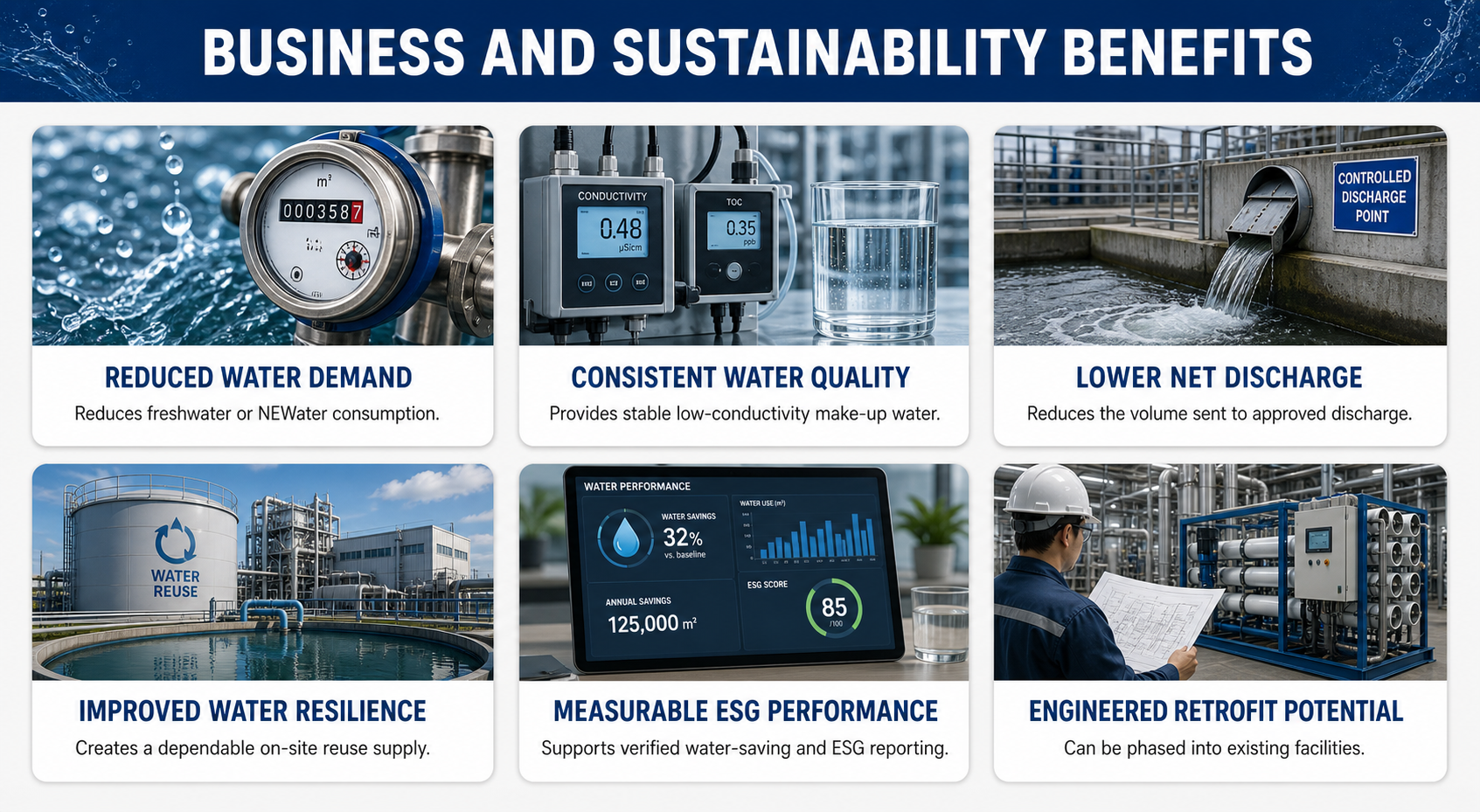
Business and Sustainability Benefits
A properly engineered condensate-recovery system can improve water efficiency, operating resilience and measurable sustainability performance.
Industries That Can Benefit
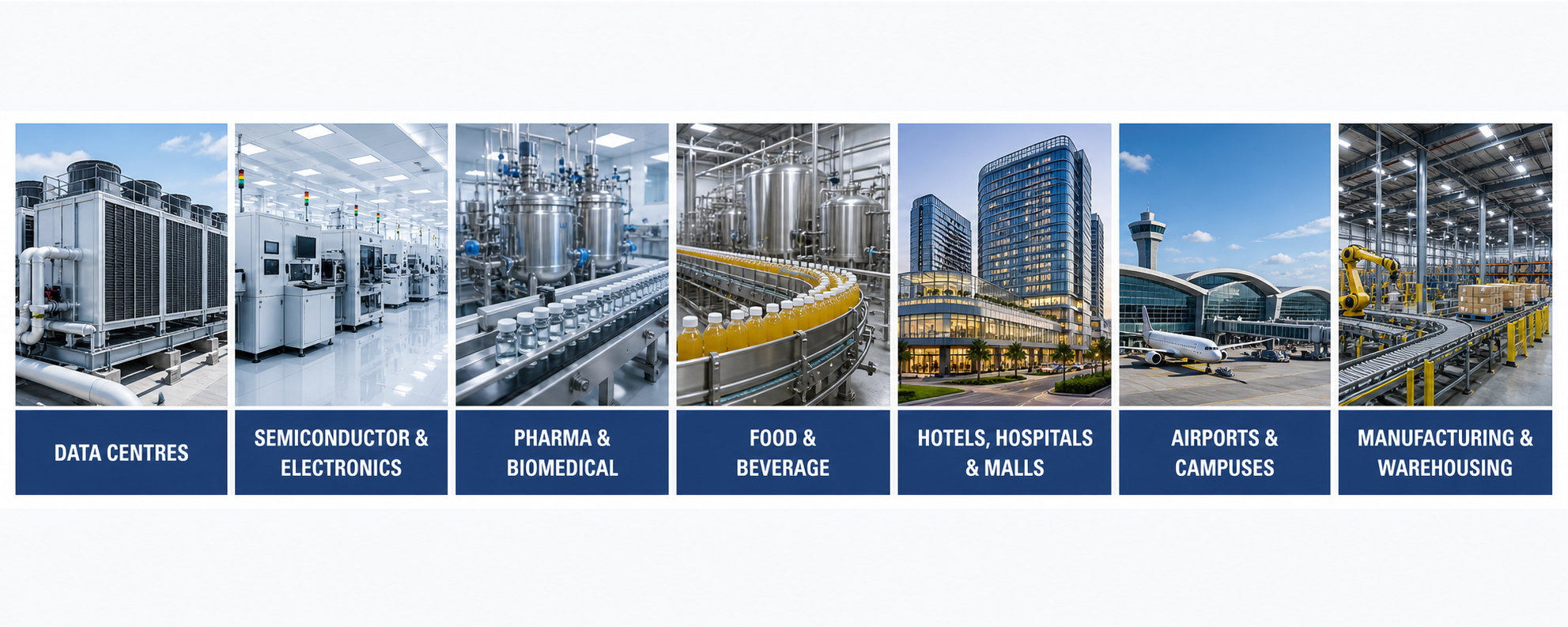
Data Centres
Large cooling loads create dependable condensate for monitored reuse, reduced water demand and improved utility resilience.
Semiconductor and Electronics
Continuous cleanroom cooling and dehumidification can provide high-volume recovery opportunities with strict system segregation.
Pharmaceutical and Biomedical
Humidity control and high ventilation rates can generate recoverable condensate for controlled non-product-contact reuse.
Food and Beverage
Cold rooms and conditioned production areas can support segregated cooling-tower make-up after hygiene and risk review.
Hotels, Hospitals and Malls
Long air-conditioning hours and high outside-air loads enable reliable collection and measurable utility-water savings.
Airports and Campuses
Distributed AHUs allow phased connection of the highest-yield buildings before expansion across the wider site.
Manufacturing and Warehousing
Central cooling and large ventilation systems can integrate recovered permeate with existing utility-water infrastructure.
Singapore Water-Efficiency and Funding Context
PUB encourages non-domestic users to improve water efficiency, meter cooling-tower make-up and blowdown, optimise cycles of concentration and consider recycling or alternative water sources. Cooling tower condensate recycling can support these objectives when it is designed around site-specific water quality, safety and operating requirements.
Eligible organisations may explore PUB’s Water Efficiency Fund for water-efficiency assessments, pilot studies, recycling or use of alternate water sources, and adoption of water-efficient equipment. Funding criteria and conditions can change, so applications should be discussed with PUB and reviewed against the latest published requirements before a project starts.
Frequently Asked Questions
How does World Technologies deliver the solution?
World Technologies follows a complete eight-stage implementation pathway:
- Water audit and opportunity screening: Review water bills, cooling-tower data, AHU schedules, drainage drawings and operating hours.
- Site survey, sampling and flow measurement: Map condensate sources, verify accessibility, measure flow and analyse representative water quality.
- Water balance and recovery feasibility: Compare condensate production with cooling-tower demand and validate the target recovery using membrane projections and residual-stream calculations.
- Process and detailed engineering: Size tanks, activated carbon, UF and two-pass RO systems, pumps, piping, instruments, controls, electrical loads and the cooling-tower connection.
- Equipment supply and installation: Supply and integrate the complete treatment train, controls, meters, valves and identified non-potable pipework.
- Commissioning and performance testing: Verify UF integrity, RO rejection, conductivity, recovery, alarms, diversion modes, backup make-up and cooling-tower delivery.
- Operator training and documentation: Provide operating procedures, cleaning guidance, sampling plans, alarm responses and equipment documentation.
- Operation, maintenance and optimisation: Support media replacement, membrane cleaning, calibration, performance trending, spare parts and ongoing system optimisation.
Is AHU condensate the same as cooling tower blowdown?
No. AHU condensate forms when moisture in air condenses on a cooling coil and is normally low in dissolved minerals. Cooling tower blowdown is circulating tower water discharged to control dissolved-solids concentration. The streams have different characteristics and treatment needs.
Why use activated carbon before UF and RO?
Activated carbon provides protection against selected organic compounds, odour-causing substances and oxidising contaminants that may affect downstream membranes. The final carbon specification and replacement interval are based on feed-water analysis and operating data.
What does ultrafiltration remove?
UF is used to reduce suspended solids, turbidity, colloids and a substantial proportion of microorganisms. It protects the RO system, but dissolved salts pass through UF and are subsequently removed by reverse osmosis.
Why is a two-pass RO system used?
The first RO pass removes most dissolved salts and membrane-rejected contaminants. The second pass polishes the first-pass permeate to provide more stable low-conductivity water for cooling-tower make-up and tighter quality control.
Does two-pass RO automatically provide 90% recovery?
No. Two-pass RO primarily improves permeate quality. A target of up to 90% overall recovery requires site-specific membrane projection, appropriate staging and, where validated, controlled reject recycle. Feed quality, scaling and fouling limits, temperature, membrane design and the approved concentrate route determine the sustainable recovery.
How much make-up water can the complete system provide?
Available make-up equals captured condensate multiplied by the demonstrated treatment recovery and is limited by simultaneous cooling-tower demand. World Technologies measures condensate flow and develops a seasonal water balance rather than relying on a generic estimate.
What happens to UF backwash and RO concentrate?
These residual streams are quantified in the design water balance and routed to an approved reuse, treatment or disposal point. They are not counted as recovered make-up water. Cleaning waste is segregated and managed according to the chemicals used and applicable site requirements.
Can an existing building be retrofitted?
Yes, many projects can be phased by connecting accessible high-yield AHUs first. Feasibility depends on drain routing, tank and membrane-skid space, electrical capacity, concentrate routing, cooling-tower controls and shutdown requirements.
Is the treated condensate potable water?
No. This application is designed as controlled non-potable cooling-tower make-up. Pipework, storage and connections remain segregated from drinking-water systems and must comply with applicable local requirements.
Can World Technologies help with a PUB funding application?
World Technologies can prepare the water audit, baseline, treatment concept, water balance, savings estimate, technical proposal and measurement plan that support a funding assessment. Eligibility and approval remain subject to PUB’s current criteria and review.
Start with a Condensate Recovery Assessment
World Technologies helps facility owners convert AHU condensate into monitored two-pass RO permeate for controlled cooling-tower make-up. Our team combines water-treatment engineering, HVAC utility integration, instrumentation, installation and lifecycle support to deliver a solution suited to each industry and site.
Contact World Technologies to arrange a cooling tower condensate treatment assessment, condensate-flow survey, membrane projection or water-efficiency feasibility study for your facility in Singapore or across the region.