Purified Water (PW)
Commonly used for non-parenteral products, equipment cleaning, final rinsing and process duties where the approved specification requires pharmaceutical Purified Water.

Pharmaceutical water engineering · Singapore and Southeast Asia
World Technologies designs, supplies, installs, commissions and supports pharmaceutical high-purity water systems for manufacturing, equipment cleaning, formulation, laboratory and utility duties. Every system begins with the user requirement specification, feedwater analysis, required water grade, demand profile and contamination-control strategy.
Discuss your pharmaceutical water requirement →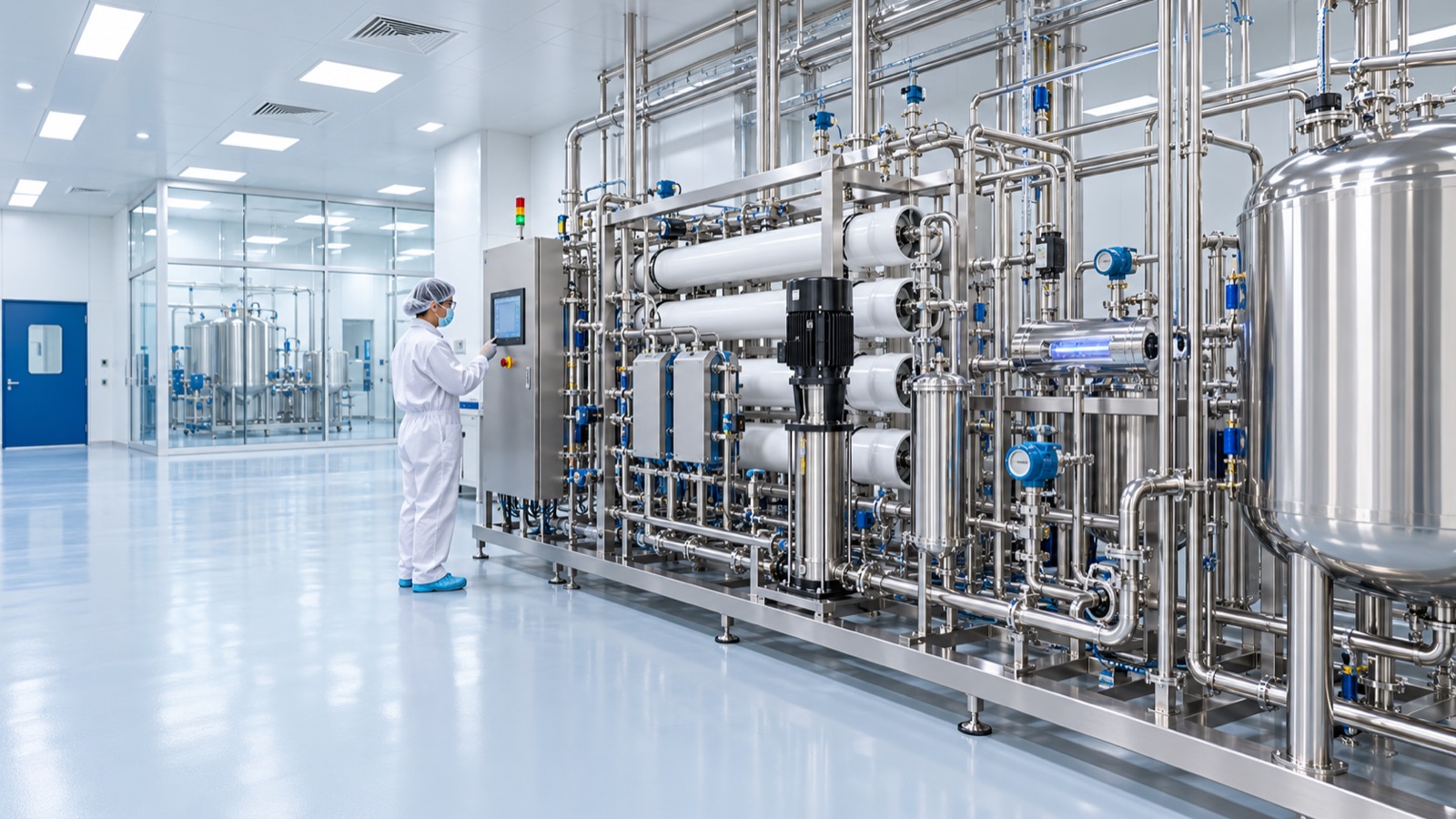
Application-led water quality
“High Purity Water” is a useful engineering description, but the contractual quality must be defined by the intended pharmaceutical use and applicable compendial or site specification. World Technologies helps pharmaceutical and biopharmaceutical companies in Singapore translate that requirement into a controlled generation, storage and distribution system.
Commonly used for non-parenteral products, equipment cleaning, final rinsing and process duties where the approved specification requires pharmaceutical Purified Water.
Used for critical parenteral and other specified applications. The generation and distribution concept must follow the applicable pharmacopoeia, contamination-control strategy and validated operating method.
High-purity laboratory water can support media, reagent and analytical work. Quality is defined by the instrument, method and laboratory procedure rather than assumed from one generic grade.
The appropriate grade for formulation, fermentation support, equipment cleaning, CIP and final rinse is confirmed through product, process and quality-risk assessment.
Singapore GMP context: HSA adopts the current PIC/S GMP Guide for medicinal-product and API manufacturing. Final water specifications, validation scope and acceptance criteria remain the pharmaceutical manufacturer's responsibility and must match the authorised process.
Complete treatment train
The exact sequence is confirmed by feedwater quality and the required point-of-use specification. A robust pharmaceutical PW or HPW system may include the following barriers and controls.
Define capacity, peak demand, water grade, points of use, sanitisation philosophy, redundancy, monitoring, documentation and acceptance requirements before equipment sizing.
Manage flow variation and protect downstream membranes using suitable screening, multimedia filtration or ultrafiltration based on turbidity, particles and microbial risk.
Activated carbon, chemical reduction, softening or antiscalant control may be selected to manage chlorine, hardness, organics and scaling potential without compromising the hygienic design strategy.
A defined final barrier protects the RO system and provides stable feed quality. Differential pressure and replacement criteria support repeatable maintenance.
RO removes most dissolved salts, organics and particles. A second pass may be used when feed variability, conductivity targets or downstream polishing requirements justify it.
Continuous electrodeionisation polishes RO permeate for low-conductivity pharmaceutical water without routine acid-and-caustic resin regeneration.
Appropriate UV wavelengths, sanitary filtration and optional ultrafiltration are selected to control microbial risk, residual organics, particles and—where specified—endotoxin.
A suitably finished stainless-steel tank can include spray-device coverage, sanitary vent filtration, level control and a drainable arrangement designed around the sanitisation method.
Sanitary 316L stainless-steel or approved polymer distribution maintains velocity and water quality from storage to each point of use, with dead-leg control and hygienic valves.
Conductivity, TOC, flow, temperature, pressure and other agreed critical parameters are monitored at defined locations, with alarms, sampling points and return-loop control.
Hygienic engineering
Material selection, surface finish, orbital welding, slope, drainability, hygienic valves and documented weld control are specified according to the approved design.
Hot-water, ozone, chemical or other validated sanitisation methods are selected for the generation skid, tank and loop according to system materials and operating strategy.
PLC/SCADA controls, user access, alarms, trends and electronic records can be configured around the facility's data-integrity and 21 CFR Part 11 requirements where applicable.
Representative sampling points and calibrated instruments support chemical and microbiological monitoring, alert/action levels, trending and investigation.
GMP project documentation
World Technologies can coordinate the engineering documents required for a controlled pharmaceutical water project, with the final validation strategy approved by the customer's Quality function.
Local lifecycle support
World Technologies provides high-purity water generation, purified-water storage and sanitary distribution-loop solutions for pharmaceutical, biopharmaceutical, healthcare, medical-device, cosmetics and laboratory facilities in Singapore. Our scope can cover a new plant, capacity expansion, compliance-driven upgrade or performance recovery of an existing pharmaceutical water system.
Review the existing system, feedwater, demand, quality risks, sanitisation approach and future capacity before developing the treatment concept.
Coordinate process engineering, equipment supply, controls, installation, commissioning and agreed qualification documentation.
Address unstable conductivity, microbial excursions, insufficient capacity, high reject flow, ageing controls or distribution-loop limitations.
Provide preventive maintenance, RO membrane CIP, calibration coordination, sanitisation support, consumables, critical spares and troubleshooting.
Frequently asked questions
It is an engineered generation, storage and distribution system that produces water to a defined pharmaceutical or site specification. “HPW” alone is not a universal compendial grade, so the approved application and quality requirements must be confirmed first.
Purified Water and WFI are distinct pharmaceutical water grades with different applications and quality expectations. WFI is used for the most critical parenteral and specified duties. The required grade should follow the applicable pharmacopoeia, product process and regulatory strategy.
A typical train can include pretreatment, RO, a second RO pass where justified, EDI/CEDI, UV or TOC control, final filtration, hygienic storage and a continuously recirculating sanitary distribution loop.
Some pharmacopoeias permit membrane-based WFI when the complete process is proven equivalent or superior to distillation and the system meets the applicable requirements. The manufacturer must confirm the permitted route and validate microbial and endotoxin control.
Continuous recirculation, suitable velocity, hygienic materials, drainability, controlled temperature or another validated microbial-control strategy help preserve water quality between the storage tank and points of use.
Depending on materials and design, sanitisation may use hot water, ozone, chemicals or another validated method. The generation skid, storage tank and distribution loop must be considered as one system.
The project scope can include URS and DQ support, risk assessment, P&IDs, material and instrument records, FAT, SAT, IQ/OQ support, commissioning documents, operating manuals and training. The customer's Quality team retains approval of the validation lifecycle.
Yes. We can assess capacity, conductivity, TOC, microbial control, RO recovery, EDI performance, tank and loop hydraulics, sanitisation, instrumentation and controls before proposing a phased retrofit.
Yes. World Technologies supports suitable pharmaceutical high-purity-water systems in Singapore with preventive maintenance, RO membrane cleaning, consumables, calibration coordination, sanitisation support, troubleshooting and performance optimisation.
Provide the feedwater analysis, required water grade and limits, average and peak flow, daily demand, operating schedule, points of use, return-loop conditions, sanitisation preference, redundancy needs, available utilities, footprint and documentation requirements.