
High-Purity & Process Water
Electrodeionization (EDI) Water Treatment Systems
EDI systems deliver continuous high-purity deionised water after RO without routine chemical regeneration for pharmaceutical, power and semiconductor use.
Discuss Your Requirement
EDI and CEDI Water Treatment Systems for High-Purity Water
World Technologies designs, supplies, commissions and maintains electrodeionization (EDI/CEDI) systems for semiconductor ultra-pure water, pharmaceutical high-purity water, power generation and industrial process-water applications in Singapore, Malaysia and Southeast Asia.
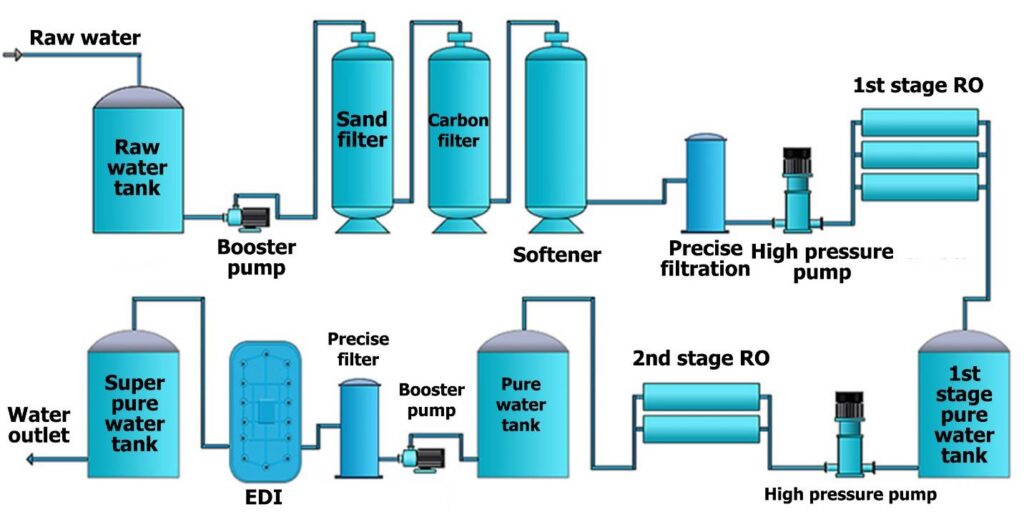
Installed after reverse osmosis, EDI combines ion-exchange resins, selective membranes and direct current to continuously remove dissolved ions without routine acid and caustic regeneration. Each RO–EDI/CEDI train is engineered around feedwater chemistry, flow, recovery, product-water quality and point-of-use requirements.
How an EDI/CEDI system works
Reverse osmosis first removes most dissolved salts, organics and particles. The RO permeate then enters the EDI module, where an electrical field drives cations and anions through ion-selective membranes into a concentrate stream. Ion-exchange resin inside the module supports efficient ion transport and is continuously regenerated by the electrical process.
This continuous process can deliver stable, high-resistivity product water while avoiding the routine chemical regeneration required by conventional mixed-bed deionisers. Final quality depends on feedwater chemistry, pretreatment, membrane condition, carbon dioxide, silica, temperature, flow and operating current, so every system should be correctly sized and monitored.
EDI/CEDI system design and supply
We provide complete RO–EDI/CEDI solutions rather than treating the EDI module as a stand-alone component. Our engineering scope can include pretreatment, cartridge filtration, single- or double-pass RO, antiscalant or pH control, membrane degassing, EDI/CEDI polishing, UV, ultrafiltration, storage, distribution loops and online water-quality monitoring.
- Feedwater review, process selection and system sizing
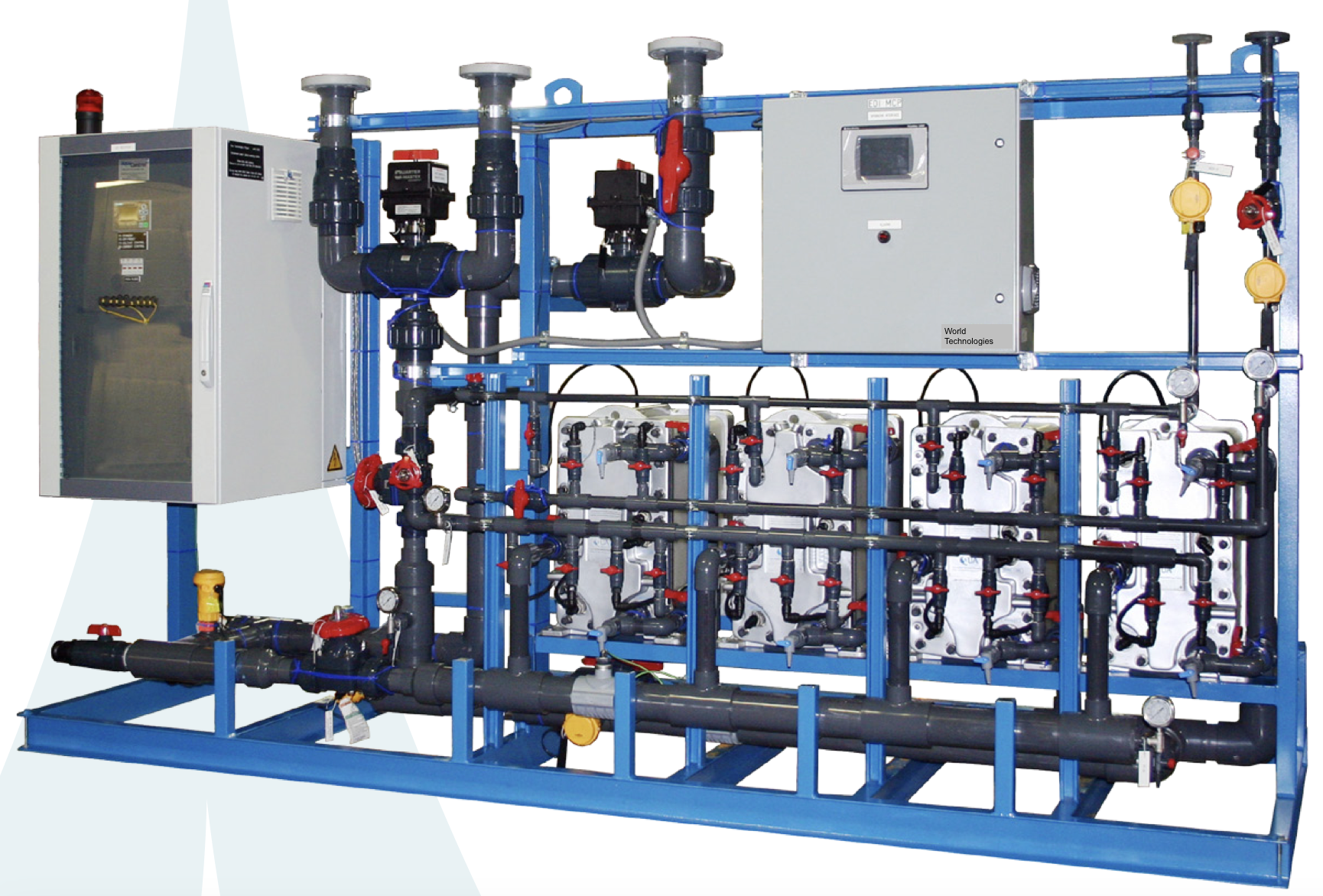
- Skid-mounted RO–EDI/CEDI packages and control panels
- Conductivity, resistivity, silica and TOC monitoring options
- Commissioning, performance testing and operator training
- Upgrade and retrofit support for existing high-purity-water plants
Semiconductor ultra-pure water applications
EDI/CEDI is commonly used as a polishing step in semiconductor and microelectronics UPW systems. It helps reduce ionic load before downstream UV oxidation, ultrafiltration, final polishing and the point-of-use distribution loop. We support new systems, capacity expansion, troubleshooting and continuous improvement for high-purity-water plants.
Pharmaceutical high-purity water applications
For pharmaceutical facilities, RO–EDI/CEDI may form part of a purified-water generation train when selected and validated against the project’s required pharmacopoeial, process and quality standards. System design must consider pretreatment, microbial control, sanitisation strategy, storage and distribution—not only conductivity or TDS.
Operation, maintenance and troubleshooting
Our in-house technicians and supervisors provide preventive maintenance, emergency troubleshooting and performance optimisation for EDI/CEDI, RO, mixed-bed and high-purity-water systems. Support is available for clients in Singapore, Malaysia and across Southeast Asia.
- Module inspection, cleaning assessment and performance trending
- RO membrane, pump, dosing and pretreatment checks
- Conductivity, resistivity, flow, pressure and instrument verification
- Investigation of scaling, hardness leakage, carbon dioxide and silica issues
- Consumables, spare parts and planned shutdown support
- Operator training, maintenance records and improvement recommendations
Key benefits of EDI/CEDI
- Continuous production of high-purity deionised water
- No routine acid or caustic regeneration of the EDI module
- Consistent product-water quality when feed conditions remain within design limits
- Compact, automated operation suited to continuous industrial processes
- Reduced chemical handling compared with conventional regenerable ion exchange
EDI/CEDI high-purity-water system
RO–EDI system
Frequently asked questions
What is the difference between EDI and CEDI?
EDI means electrodeionization. CEDI means continuous electrodeionization and is commonly used to emphasise that the process operates continuously. In industrial practice, the terms are often used for the same technology.
Does EDI replace reverse osmosis?
No. EDI is normally installed after RO. Reverse osmosis removes the bulk of dissolved solids and protects the EDI module, while EDI provides final ionic polishing.
What feedwater quality does an EDI system require?
Allowable hardness, conductivity, carbon dioxide, silica, temperature and oxidant levels depend on the selected module and design. Feedwater must be checked against the manufacturer’s limits before sizing or operating the system.
Can you maintain existing EDI/CEDI systems?
Yes. Our in-house team supports troubleshooting, preventive maintenance, instrumentation, RO pretreatment, module performance and complete high-purity-water trains across Southeast Asia.
Request an EDI/CEDI system assessment
Send us your feedwater analysis, required product-water quality, flow rate, operating hours and application. We can review a new RO–EDI/CEDI system, an upgrade or an operation-and-maintenance requirement.
Call or WhatsApp: +65 8268 2912
Email: [email protected]
Explore our semiconductor UPW systems, water-treatment plant operation and maintenance and RO and UF membrane services.