Low-temperature vacuum evaporation
Operating under vacuum lowers the boiling temperature. Water is evaporated and condensed as distillate while salts, metals, non-volatile organics and solids are concentrated into a smaller residual stream.
World Technologies delivers High COD Wastewater Treatment using Vacuum Evaporation and Advance Oxidation Process (AOP) solutions, equipment and lifecycle support for reliable industrial water and wastewater operations in Singapore and the region.
Discuss Your Requirement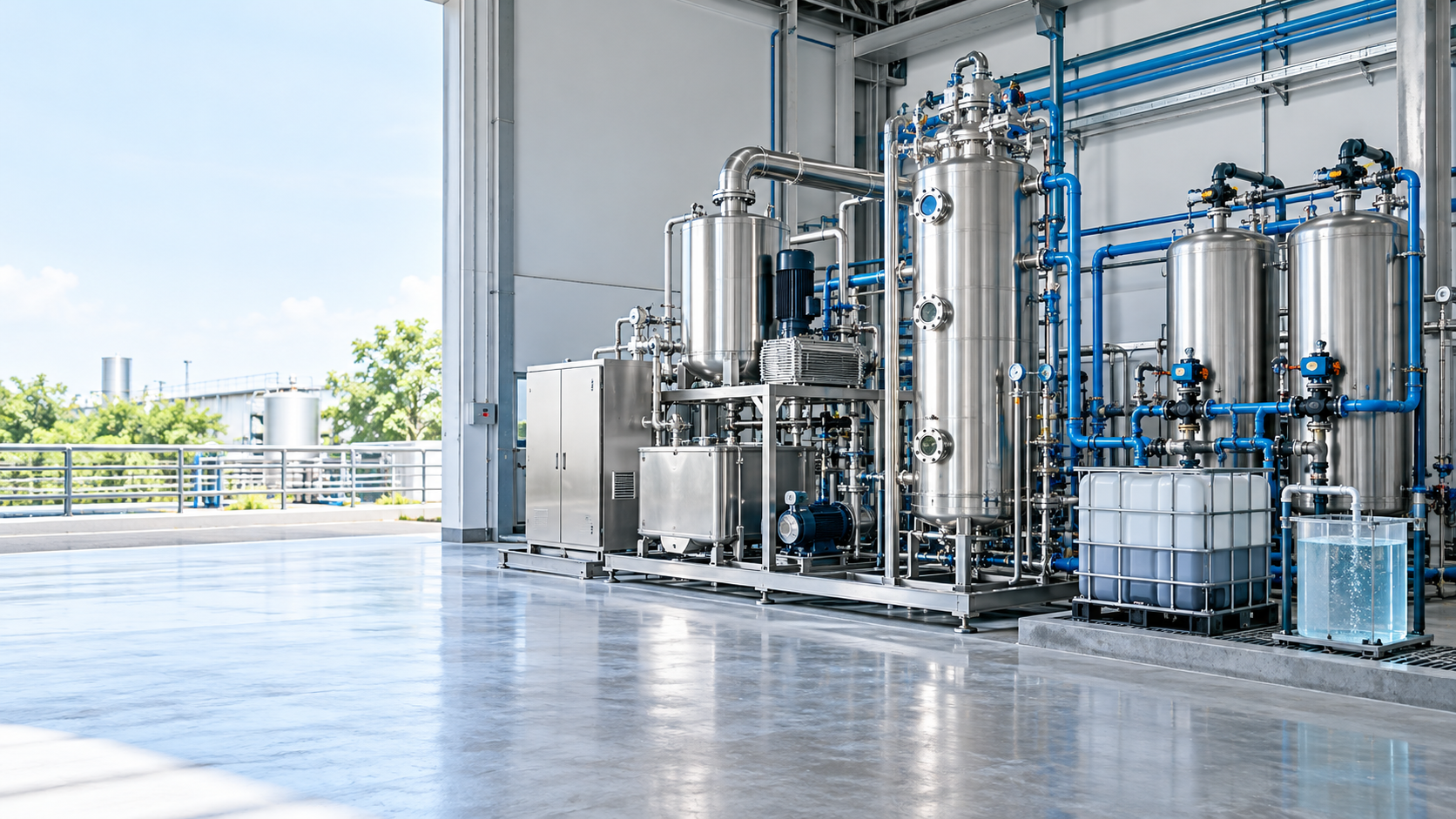
A compact, application-led treatment train for difficult industrial effluent, combining physical separation, advanced oxidation and final adsorption polishing.
World Technologies assesses, designs, integrates and supports high-COD wastewater systems for chemical, pharmaceutical, semiconductor, electronics, metal-finishing and other demanding industrial facilities.
High COD can arise from concentrated organics, solvents, oils, surfactants, dyes, resins, production chemicals and other compounds that may be difficult to biodegrade. Variable batches, high salinity, toxicity and limited space can make a standard biological plant unreliable or impractical.
Operating under vacuum lowers the boiling temperature. Water is evaporated and condensed as distillate while salts, metals, non-volatile organics and solids are concentrated into a smaller residual stream.
An application-specific oxidation stage targets selected residual organic compounds. The reactor chemistry and contact conditions are confirmed by treatability testing and may use a catalytic or other suitable hydroxyl-radical-generating process.
GAC provides a final adsorption barrier for suitable trace organics, colour and odour. Media type, bed depth, hydraulic loading and replacement frequency are selected from the polished-water duty.
The evaporator is selected only after reviewing feed variability, solids, viscosity, foaming tendency, scaling potential, chlorides, volatile compounds, heat source and required recovery.
| Configuration | Best suited to |
|---|---|
| Scraped / agitated evaporator | Sludge-bearing, scaling, viscous or high-solids wastewater where wall cleaning and concentrate handling are critical. |
| Low-temperature vacuum evaporator | Industrial wastewater where lower boiling temperature, compact installation and controlled water recovery are important. |
| Modular multi-unit arrangement | Phased capacity, redundancy, variable campaigns or future expansion. |
Separating most salts, solids and non-volatile contamination first can reduce the oxidant demand on the downstream stage. Actual performance depends on the condensate matrix and radical-scavenging species.
A properly selected AOP may transform difficult organic compounds and reduce residual COD, colour or odour. By-products and toxicity must be evaluated where relevant; oxidation is not assumed to provide complete mineralisation.
Activated carbon adsorbs suitable residual dissolved organics and provides a robust finishing barrier. Breakthrough monitoring and media-change planning are included in the operating concept.
Where requested, technically suitable and available through an authorised supply route, World Technologies can evaluate an Aquamaz-based configuration incorporating low-temperature vacuum evaporation, an oxidation reactor and GAC polishing within the overall treatment plant.
Final equipment brand, supply responsibility, guarantees and acceptance criteria are confirmed in the project proposal. We can also develop an equivalent application-specific treatment train using approved technologies.
Review production sources, flow balance, safety data, historical laboratory results and the required outlet quality.
Perform representative bench or pilot testing to assess evaporation behaviour, condensate quality, oxidation response and carbon loading.
Define process guarantees, materials, controls, utilities, concentrate handling, installation, commissioning, operator training and lifecycle service.
Performance figures published by any equipment supplier or observed on another wastewater are reference data only. Project guarantees require representative samples, an agreed analytical method, confirmed feed envelope and defined operating conditions.
There is no single universal threshold. High COD describes wastewater with a substantial oxidisable load relative to the receiving treatment process or discharge requirement. Treatability depends on the compound mix, biodegradability, salinity, toxicity and variability – not COD alone.
It can separate many non-volatile organic contaminants from water and concentrate them in the residual stream. Volatile or entrainable compounds may carry into the distillate, so condensate testing and downstream polishing are essential.
No universal claim is appropriate. AOP performance depends on the target compounds, water matrix, radical scavengers, contact time and reactor conditions. Testing is used to establish achievable removal and identify oxidation by-products.
GAC can adsorb suitable residual dissolved organics, colour and odour compounds, providing a final polishing barrier and helping stabilise the treated-water quality.
Potentially. The reuse application determines the required treatment and monitoring. Distillate intended for cooling, washing, utilities or process reuse must be verified against the site-specific quality specification.
Yes. World Technologies can support assessment, pilot planning, process design, installation, commissioning, training and lifecycle service for suitable projects in Singapore, Malaysia and the wider Southeast Asia region.
Send your wastewater source, daily volume, COD/TDS profile, discharge or reuse target and available utilities. We will recommend the next treatability and engineering steps.